Creating a future-state vision for the strategic client meeting experience
What began as an ask from the stakeholder to interview client-facing teams on how to make strategic client meetings more interactive and dynamic evolved into a roadmap for a re-imagined end-to-end experience for client-facing teams, from meeting prep to post-meeting follow up
Collaborators
Director, Employer & Advisor Marketing
UX Design
Year
2022-2023
Role
Lead UX Researcher
Problem Statement & Goals
Annual Service Review meetings with clients are a critical part of the strategic ongoing dialogue that account executives have with their clients to review their benefits programs and find ways to deepen the engagement and demonstrate our value.
The Client Relationship Engagement team was looking to improve upon the current experience by delivering teams an innovative medium to “wow” clients during these strategic meetings. As part of this effort, they were looking to gather feedback from client-facing teams to identify and prioritize the key requirements that should be included as part of the first phase of delivery that was planned later in the year.
I encouraged the team to take a step back and question their assumptions around creating an “innovative medium” and rather, test their hypothesis rather than try to validate it. My recommendation was to start with foundational research in order to understand how well the current experience is meeting the needs of client service teams and where the greatest opportunities lie.
Research Objective
Identify key user goals, needs, pain points and opportunities as it relates to the annual service review meeting experience that will help inform the content, features and capabilities that will be most valuable in a solution developed to address these needs.
Key Research Questions
What are the key goals and desired outcomes of these strategic meetings?
What is the current process and associated pain points for planning and delivering these meetings?
Who is involved in the creation of the meeting materials and presentation, and what does that collaboration look like?
What tools, platforms and sources of information do client service teams leverage for these meetings?
What capabilities or features would be most valuable for the client-facing team in a potential solution?
Participant Recruitment & Methodology
Who I Talked To
22 internal associates that represent all members of the client-facing team
10 Account Executives (the primary contact for the HR benefits administrator)
5 Communications Consultants (responsible for employee engagement efforts and targeted communications)
2 Client Service Managers (responsible for day-to-day operations of the plan)
5 Creative Consultants and executive admins
I also recruited 3 HR benefits administrators to get an outside-in perspective on how these strategic client meets are received and what plan sponsors are hoping to get out of these meetings
What I Did
Hour long, 1:1 in-depth interviews over Zoom

Key Findings
Based on the findings generated from the interviews, I synthesized and distilled the insights into key opportunity areas that emerged consistently throughout the interviews. The biggest takeaway from the research was that users don’t need more bells and whistles - they have everything they need but rather, want a more streamlined and efficient process for pulling everything together.
Timely & relevant content (e.g. stale data, “what’s new?” alerts)
Help with storytelling (i.e. slides are too data-heavy)
Real-time collaboration capability so that service teams can work on the presentation contemporaneously and reduce bottlenecks
Improvement in the search and IA in the content repository platform
A turnkey solution that is easy to rinse and repeat for many clients at scale
Best practices sharing among peers/colleagues
Recommendation engine that helps teams get to the “so what” faster
As part of the final deliverable, I also created a user journey map that documented the end-to-end process for preparing for these meetings. I also highlighted key differences that existed by role and by market segment (every segment has a different service delivery model based on the asset size of the plan).
Recommendations
My recommendations were for the team to:
Prioritize pre-meeting support, followed by post-meeting tracking and monitoring - rather than the in-meeting experience.
Focus on supporting the lower market account executives, as they do not have the support of full client teams and have a larger book of business. Additionally, the more upmarket the clients are, the most custom the content often is
I also urged the teams to de-prioritize features & capabilities that they had planned, such as:
Reporting & Insights metrics on how clients are engaging with the deck: Research participants identified this feature as low priority, citing that their clients rarely view the deck before/after the presentation
Pre-meeting agenda planner tool: Account executives felt that using a tool to collaborate on an agenda with a client doesn’t add any value/time savings, and more importantly, removes a key touch point and opportunity to connect with the client on a personal level
Research (Round 2): Concept Resonance Test
The research conducted provided a strong foundation on which the team could converge around an end-to-end vision for a future state meeting experience from prep to post-planning.
The engagement team, myself, and other key stakeholders in Marketing and data teams met the following summer at an off-site to collaborate with client teams to define an end-to-end user journey.
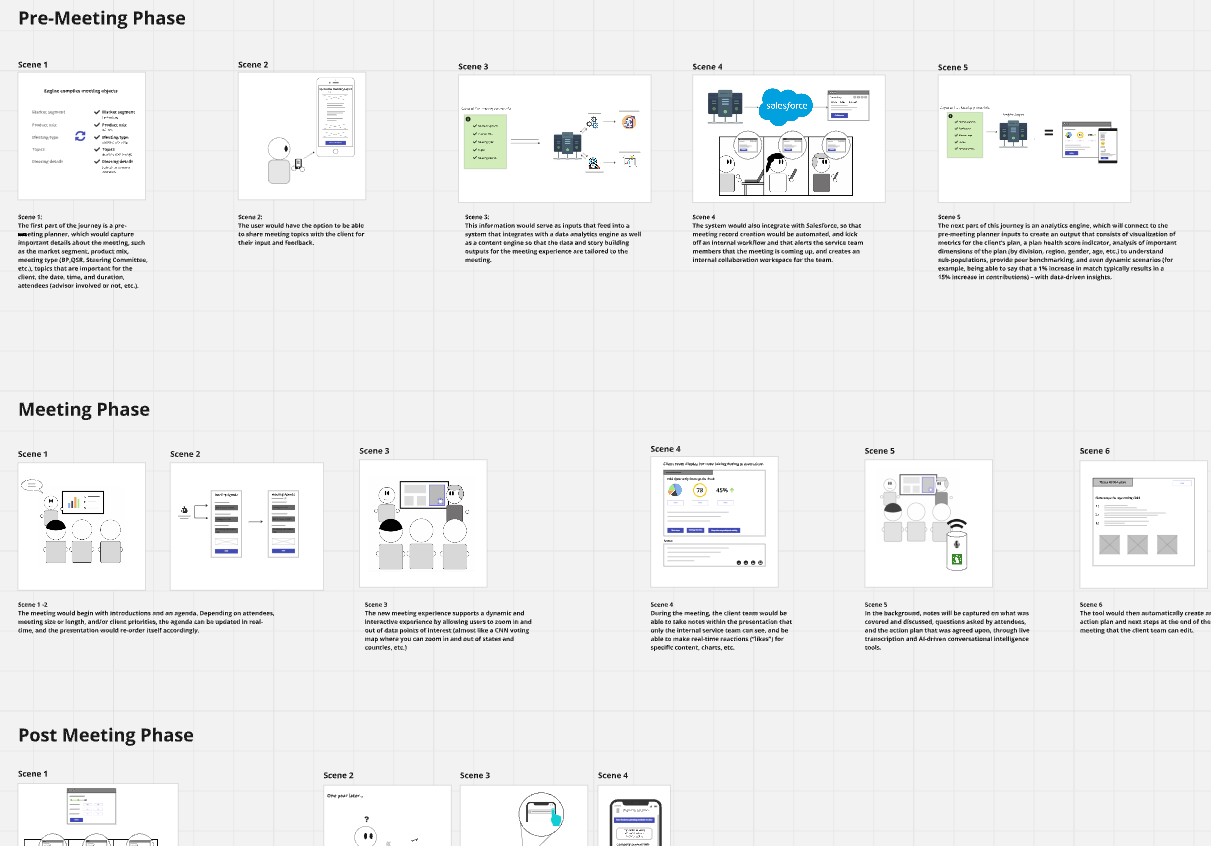
I felt that a storyboard would be the right design artifact for this study to communicate a conceptual, end-to-end vision. I purposefully wanted the visuals to look rough and lo-fi so that users knew we were in the very early, exploratory stages of solutioning. I wanted users to poke holes in the concept and encouraged them to give honest and candid feedback.
I worked with the UX designer to bring the journey to life. I wrote the captions for each frame in the storyboard, which the designer then used to sketch the storyboard frames in Miro.
Design Artifact Tested - Storyboard
Research Objective
The goal of this research was to evaluate whether the end-to-end vision defined for the re-imagined client meeting experience is in line with user needs and expectations, so that we can build a solution that addresses a true user need/problem.
High-level Research Questions
How well does the proposed end-to-end future state vision defined for the client meeting experience address a user need or problem in the current experience?
Are there user needs or problems that the proposed vision doesn’t address adequately, or at all?
Which parts of the future state vision do users have questions about or need more clarification around?
What should the team prioritize in the short, medium and long term?
Are there obstacles or barriers to adoption of the future state vision? What are they?
Participant Recruitment & Methodology
Who I Talked To
N=12 internal, client-facing associates/members of the client service team - mix of market segments and product areas
Account Executives
Communications Consultants
Client Service Managers
Mix of users who participated in the previous round of research (to get their feedback on whether we captured and interpreted the needs and pain points they shared - in the proposed solution) and new folks
What I Did
Hour long, 1:1 in-depth interviews over Zoom
Used Miro to walk participants through the storyboard

Key Findings
While overall response to the end-to-end vision was positive, flexibility in the solution will be the key to success
While automation can create efficiencies, users expressed wanting control over data parameters, the ability to overwrite system recommendations, and have the option to opt out of some proposed features
Pre-meeting planning & prep is the part of the experience that takes the most amount of time and effort
Users wanted the team to prioritize the data analytics engine and content story-builder pieces of the experience first
Today, teams have all the data under the sun for 401k plans but struggle to tell an integrated, multi-product data story
Recommendations
Prioritize building the data analytics engine that would enable service teams to uncover the data story more quickly and less manually and identify areas of opportunity
Clients want to know where they stand, where they were, how they are progressing towards their goals, and how they compare to their peers. A Plan Health “score,” peer benchmarking data, and a recommendations engine would be key elements of this tool
The first iteration of this tool must be able to tell the multi-product interplay + savings story for clients with 401(k) and Health Savings Account plans with us
Impact
The team built out the first iteration of the Benefits Health Tool (the data analytics engine part of the end-to-end vision) in Q4 of 2025, which is being piloted with a sub-set of service teams + clients.
The team is vetting potential vendors for a new content repository with potential capabilities for a dynamic and interactive meeting experience. The findings from this research informed many of the user and business requirements for such a tool.


"We're far from tech-savvy, and Adri gave us valuable guidance on our shop's much-deserved digital makeover."
— Chef Randy